Showing posts with label orientation and mobility. Show all posts

Tuesday, February 7, 2012

Spirit of Uganda


Queen Teen's class went to see "The Spirit of Uganda," at the Wells Fargo Center for the Arts in Santa Rosa last week, and I got to go with her. The Spirit of Uganda is a performance group made up of Ugandan children and young adults who have all lost parents to AIDS and war. They travel the globe representing the organization Empower Africa's Children. From their website:

Empower African Children is a non-profit organization inspired by success stories from more than 15 years of work with Africa's vulnerable children. Launched in 2006 by child advocate Alexis Hefley - whose work with Ugandan children has earned her international acclaim - Empower African Children's programs provide a fresh new approach that unlocks the potential of this generation through an innovative education. Its holistic approach to education provides tools for success in life, creating confident, skillful, visionary leaders.

Uganda has the highest number of orphans of any country in the world. The funds raised during the tour go to the orphanage and education program supported by Empower Africa's Children. The performance also shares the beauty and excitement of Ugandan music and dance, which I admit I knew almost nothing about.

The only things I knew about Uganda were Idi Amin,  AIDS, and the persecution of homosexuals. I didn't even know where exactly the country was located in Africa. Watching the performance made me curious, so I went on line and explored the history and culture of Uganda. With Lake Victoria as its southern border, Uganda is a part of the Nile river delta, rich with fish, game and plants. But it is a poor country, with more than 50% of the population under the age of 15 and the average lifespan for women age 52 (47 for men). These are the facts you'll get from reading Wikipedia, which could paint a mighty bleak image of Uganda, or any African country for that matter. What the Spirit of Uganda shows us is the heart and soul of the nation, not the hardship. The country is rich with resources and people. The humans who live there struggle, but also create beauty. Seeing the children dance while listening to the drums and songs helped me understand the strength of the people of Uganda, and made me want to visit there. Maybe I will someday.


As Queen Teen's Mobility teacher, it was my job to drive her and a friend to the theatre, and then arrange for them to go back stage to meet some of the performers. It's very hard for Queen Teen to see and understand what's happening on stage, even from the front row, so seeing a performer up close is really helpful.

We were guided back stage by the center's Education Program Director, who has been incredibly helpful every time Queen Teen has gone to see a show there. The performers, ages 11 through 20, were fabulous. Several dancers came out to meet Queen Teen and show her their costumes. They got really close so she could see what they were wearing, including the feathered belts around their waists and the bells on their ankles. And they talked directly to her, waited for her response, allowed her to touch their clothing and shake their hands. No one seemed nervous around a deaf-blind young woman in a wheel chair; they treated her like any other student wanting to meet performers before a show. The generosity of the young performers and the kindness they showed Queen Teen, without any hint of pity, impressed me greatly. (Here's a link from the Wells Fargo Center blog, and if you scroll to the bottom of that page, you'll see a picture of Queen Teen in her pink coat meeting the performers.)

And the show impressed everyone, including Queen Teen. She loved the drums and the dances, but got a little lost with the story telling (hard to understand when you can't hear the guy talking and both you and the person interpreting don't know enough ASL to help). Toward the end of the show, the storyteller invited us all to stand and dance with the performers. I jumped up and held out my hands to Queen Teen, who surprised me by standing, gripping my hands tightly, and dancing with the rest of the audience. She was grinning like a little kid and dancing as wild as her body would let her without falling. I kept a tight grip on her so she could lift her legs and flap her arms. When the dance was over, she said, "You thought I couldn't dance!" She was still grinning when the show ended, and she clapped as hard as her little hands could. 

If The Spirit of Uganda comes to your town, go see it.  You will be inspired and thoroughly entertained. Tell them Queen Teen sent you.

Wednesday, November 9, 2011

4th anniversary of the first book I published, or, how I became an orientation and mobility teacher.


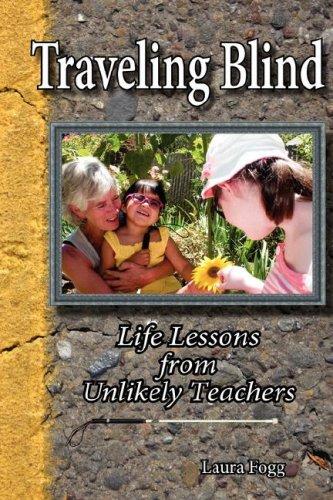
This past weekend marks the four year anniversary of when I published the first book from my press, Medusa's MuseTraveling Blind: Life Lessons from Unlikely Teachers, by Laura Fogg, is a memoir of Laura's 30 + years teaching children with vision impairments, and ultimately what those children taught her about life, love, loss, and joy. Laura has been my daughter's teacher since Queen Teen was 3, and when I discovered Laura was also a talented writer, I offered to publish her book. After a year-and a half of edits, revisions, and debates over cover design and font choices, her book was launched at the California Association of Orientation and Mobility Specialists Conference. The other teachers were excited and impressed, and we sold almost 100 copies in two days. Laura was ecstatic and I was thrilled. I was also intrigued by the other O and M teachers I met at the conference and the work they so obviously loved doing. A few days after the launch of Traveling Blind, I decided to go to Graduate School and become an O and M teacher too.

Four years later, I attended the Orientation and Mobility Conference again, this time as a credentialed O and M Specialist with a Master's Degree and a job working side-by-side with Laura. I'm still a publisher, but I'm also a teacher, working with visually impaired students throughout all of Mendocino County. It was a long, exhausting crawl to get my degree, as many of you saw if you've been reading my blog for the past three years, but so worth it. I love teaching, I love Orientation and Mobility, and I love my students.

The conference is held every other year in Monterey at a hotel right on the beach. About half of my classmates from SF State were there, as were my teachers. My main focus as a teacher was learning about GPS systems for the visually impaired because I have a student who may benefit from using such a device (see, I already sound like a teacher. "may benefit from using such a device." lol). On Saturday was a GPS treasure hunt in downtown Monterey where teams of six competed against each other to find all the clues and get to the last location before anyone else. Our leader was a visually impaired man who just so happens to be the President and CEO of Sendero Group, the manufacturer of the GPS we were using. Is that why we smoked the other teams, arriving 20 minutes before anyone else at the bar, where we waited near a warm fire and drank cold margaritas? But the best moments for me were when I got to spend time with my classmates, catching up on our lives and our teaching jobs while sharing wine and champagne. I've missed everyone so much! It's like we're part of a submarine crew, a small group of highly trained people sharing very specific experiences that hardly anyone else can really understand.

There was a raffle to raise money for the scholarship fund, so I donated four copies of Traveling Blind. As I was sitting in the audience listening to a speaker talk about the pros and cons of using GPS on a smart phone, it suddenly hit me how much my life has changed since the first time I was at this conference. Last time I was a publisher sitting behind a table covered in copies of Laura's book. Now I'm a teacher, just like Laura.

I'll always be a book publisher; no way will I give that up. But it's very hard to make a living publishing books, so I teach to support my book habit. Thank goodness I love my "real" job. 

Tuesday, May 31, 2011

Living the Theory of Relativity

image from Prosperity Blogger 


Time slows down to a crawl when I'm home. I feel as if I'm zooming as I clean and cook and work in the yard; as I work on promoting my press and answering emails; as I help my daughter dress, make her bed, comb her hair, do an art project. But in actuality, time inside my home slows down as compared to the outside world. When I think only a few days have passed, I discover that in the outside world a week has flown by. I feel like I'm inside Einstein's theory of relativity and I am the twin traveling at the speed of light, in which time slows down, while my sibling ages and dies back on Earth, where time continues to flow at a somewhat-steady 365 days in a year.

For example, it is the last day of May. This afternoon I have a job interview, which I'm very excited about (and nervous! I've never been interviewed as an O and M candidate before. What are they going to ask me?). The application process requires three letters of recommendation. No problem, I thought. I'll just ask my Master Teacher and my Instructor and the woman I worked with when I was a Family Advocate... holy cow! Is it really May 26? I thought I still had three weeks to get those letters from people. Now I have two days before a holiday weekend!

Frantic calls netted me two of my letters, but my instructor is slammed with work right now and won't have time to write me a letter for several weeks. Oh well, two letters are better than no letters, and I'll be able to show the hiring committee the third letter when it arrives. I hope.

This time management problem isn't a new phenomena, it has been going on for years. I don't return phone calls when I should because I get so busy keeping up with Queen Teen and helping my husband that its evening before I realize I never made the call. This can go on for several days, which can be annoying to people. In fact, talking on the phone is difficult period. I prefer email, because an email can adapt to my own, home-time-zone while talking on the phone jars me into dealing with the speed of the outside world.

In this day of technology, why do people insist on chatting on the phone?

Time management was easier when I was in school, because I was constantly having to navigate the two time-zones that were my life. When I was interning, I discovered the only way I could get any work done was to stay away from home. Once I set foot in my house, time slowed down again and all of my attention landed squarely on my husband, child and dog. Never mind that I needed to write client notes or return a call to my master teacher. My daughter needed something and my husband wanted to chat about his work and the dog was hungry.

It doesn't help that I'm still suffering from the post-grad school fatigue I've been feeling for a month. I suppose playing video games and watching movies isn't the best way to get any work done.

When I am working, I'll need to find a way to go back and forth between "Earth" and my "rocket ship" more easily. The outside world demands focus and speed, while my home world demands the same, but at a slower pace. Speed is relative. 

Tuesday, January 25, 2011

You can't be shy with people who can't see you

You probably don't know this, but I'm shy. I know it might be surprising, especially since I keep a blog and reveal far more details about myself than most people find comfortable. But in person, one-to-one, I'm as timid as the proverbial door mouse, tongue tied and terrified of saying something stupid. The idea of having to engage a person in conversation makes me nauseous. At parties I tend to hang in the background and wait for people to approach me, or I tag along with a few people I might already know. I can chat and fake it, pretend to be clever, or at least not stupid. And sometimes I have no idea how to end a conversation, so I probably hang around too long, like one of those annoying people at parties you can't shake.

I've been told I'm aloof and sometimes intimidating. The reality is I'm so shy I don't know how to say hello.

This became a problem when I started working with visually impaired people.

How does a person who can't see you know that you're there? How do they find out who you are, your name, and if you're still in the room or if you left?

You talk to them, of course.

Simple, right? At work, when you enter a room and there is a visually impaired person present you say hello and even if they already know your name, you tell them who you are ("Hi. It's Terena."). In fact, wouldn't it be great if everyone did that, instead of having to fumble for names? Or if you pass on the street an acquaintance who is visually impaired, say hello. It's rude to just walk on by as if they don't know you.

What did I do the first few weeks of my internship? I walked into a room and tried to be quiet so I wouldn't "bother anyone." When my instructor was talking to one of her students and she forgot to introduce me, did I say hello? Nope. I pretended I wasn't there. I kept waiting for the other person to acknowledge me first, just as I do every day, rather than take the first step. This tactic doesn't work when people can't see you. As I've forced myself to stop being rude (which is exactly what I was doing by not letting a blind person know I was there), I've also had to deal with my shyness. I'm now wondering, If I can be more outgoing with my students, can I also be more outgoing with people in general?

I've decided to give it a try. I can at least pretend to be outgoing, and then maybe eventually it will stick.


Wednesday, November 3, 2010

Full Circle - Interning with Laura Fogg

The first book I published through my press, Medusa's Muse, was called Traveling Blind: Life Lessons from Unlikely Teachers, written by my daughter's Orientation and Mobility Teacher, Laura Fogg. A memoir about her 30 years as a teacher of visually impaired children, Laura shares stories about many of her students and what each child taught her about life, joy, grief and hope. My own daughter's story is one of the chapters. I had watched her for 10 years working with my daughter, but publishing her book gave me a clear picture of what being a teacher of visually impaired people was like. Shortly after the book was released in November, 2007, I applied to the O and M program at San Francisco State.

Last week I started my internship with Laura, riding with her all over Mendocino County, teaching toddlers and high school students, both multiply disabled and able bodied, English and Spanish speaking. She also works with other teachers to help them understand a child's vision issues and parents to help them communicate their child's needs. She eats lunch in her car and rarely takes a break. Occasionally she works 10 hour days. But through it all, she seems joyful and tireless. Even when she's starting to feel the stress because everything happens at once, she has a smile on her face. 

I want to be just like her when I grow up.

Life has come full circle. Queen Teen was born visually impaired. Laura has been her teacher for 12 years. Laura wrote a memoir. I published it. Her book inspired me to go to school. Laura is now my Master Teacher.

Hey, someone tell Oprah. I think our story would make an excellent feature for her magazine.

The other perk to this internship is I now get to work with my own daughter. It kind of feels like cheating taking Queen Teen on shopping trips and nature walks after school. Queen Teen is in heaven. She likes going on outings with Laura, but with Mom in tow, it's that much better.

And this is Laura's office

Anderson Valley in October


And this...


And here's one more shot of Laura Fogg's office, which is mine for the next five weeks...

The Village of Mendocino
No wonder she loves her job.

Thursday, September 23, 2010

In other non-Burning Man news

I officially started my internship last week at the Earl Baum Center in Santa Rosa, and though I can't go into details about clients, I can say that I'm learning a lot in a very short period of time. My master teacher is an alumni of the SFSU O and M program, and had all the same teachers and classes I did. She too survived crossing 19th Avenue under blindfold, and now here she is working with clients, helping them with daily living skills, cane skills and street crossing. Gives me hope that soon I'll too have a case-load of students and my office in my car.

It's been challenging though. I'm driving three to four hours a day, from my home and then to the various client's homes throughout Sonoma County. The schedule can be hectic and some days we skip lunch trying to get to everyone. My master teacher tries hard to accommodate my needs, but a lot of the schedule is driven by client availability and location, so there's only so much she can do. I'm beginning to realize just how hard it's going to be juggling Queen Teen's continuing needs and a full time job. Will I be able to pull this off? It's looking more like I'll need to work part time for a while, with one day a week devoted to Queen Teen. How do other parents work and care for a child with disabilities? Maybe I'm just a wimp.

At the same time, I'm studying for my Master's exam in October, and my Certification exam in January. I should know all about Orientation and Mobility, right? Then why does it feel like I've forgotten every term every taught to me. Eye anatomy; common eye-conditions; the difference between a landmark and a clue; the necessary parts of a functional assessment; what color tint of shades to use for Macular Degeneration. All that info is in my brain somewhere, but I'm having to re-read much of the readings from my classes to make sense out of it.

But when I work with a client, the info appears. Instinctively I know how to teach orientation skills to a client. I may not remember all of the visual effects caused by Diabetic Retinopathy, but I do know how to teach, and I figure the details of what I learned in class will coalesce into retrievable, logical sense in my brain. Just takes a little time, and study.

Queen Teen is thrilled that I'm home evry night for dinner now. No more staying in San Fran far away from her. But I miss my weekly trips to the City by the Bay, and miss seeing my friends regularly. The City charges my batteries, so to speak. I need to plan some trips for fun.

Well, gotta get back to work. My master teacher will be here soon and then we're meeting a client. Thanks for hanging in there while I wrote about Burning Man (which everyone should go to at least once in their life).

Friday, April 2, 2010

The chaotic roar of 19th Avenue


(image from San Francisco Sentinel)

After my triumph crossing 22nd street, I immediately had to prepare myself for the next street crossing challenge: 19th Avenue.  19th Avenue in San Francisco is a major, six lane artery that runs North-South along the West side of town, through Golden Gate park and along the Sunset District. It is the path of Hwy 1 as it cuts through The City, so there are a lot of cars on that road. Thousands of vehicles, all day and all night. And somehow, I had to get my blindfolded self across that crazy road.

But first, the class learned to walk beside 19th Avenue. We met at Rivera and 19th and took turns crossing Rivera, trying to sort out the cacophony of trucks and cars and buses that fly by at 40 mph. My class partner went first, so I practiced teaching. I was amazed once again by how easily he could line himself up for a straight line of travel listening to the parallel traffic. Then it was my turn to be the student. I put on my blindfold and stood at the corner of Taraval and 19th, concentrating hard to locate the sound cue I need to cross safely. As usual, the sound swirled and echoed all around me. I heard the Muni train clatter past, but it sounded like it was on top of me. A motorcycle roared by and I jumped. I flagged my class partner and said I couldn't do it, so he guided me across. On the other side of the street I traveled down the sidewalk along 19th Ave, but still felt dizzy with the sound. Half a block later, after jumping every time a loud car went by, I pulled off my blindfold and switched to the low vision simulator.

Even with a little vision, the noise was awful. My partner encouraged me to try crossing the last street with my blindfold, and I agreed. I knew I had to get across Rivera somehow, or I'd never make it across 19th. I took a deep breath, listened hard, trusted that my partner would keep me safe, and crossed Rivera. By the time I made it across the street, my heart was pounding and I wanted to cry, but I breathed deeply and forced myself to stay calm.

One thing my partner and I were able to verify is that I am indeed hearing the echoes of traffic. Because the traffic noise sounded like it was on my right (where the road was) and left (where the buildings were), it felt like I was walking smack down the middle of 19th Avenue (probably shouldn't use the word "smack" in that sentence).  Logically, I knew I wasn't, so I didn't panic, but the sensory overload was exhausting. I had to concentrate with all my might just to walk a straight line.

How was I going to cross 19th Avenue if I couldn't even walk along it?

Monday, March 22, 2010

And there was much rejoicing when I made it across the street!


(image from Wikimedia Commons)

I thought it would never happen. After weeks of standing on street corners with my eyes closed, listening to the sounds of traffic stopping and going at intersections, feeling the sound curve around my head and crash against buildings, I finally walked across an intersection under blindfold.

Un-frickin-believable.

My class met at Guerrero and 22nd in San Francisco's Mission district for our first street crossing lesson at a traffic controlled intersection. I kept both my blindfold and my low vision simulators (glasses covered in cheesecloth) in my pocket, ready for anything. My class partner and I went to our assigned intersection and practiced listening to the traffic under blindfold until we could determine the "now" moment. The light would change and the traffic on Guerrero would surge, creating a distinct roar of cars in motion. After taking a moment to listen for right turners and red light runners, we would step forward to cross the street, our cane arcing back and forth as we attempted to keep a straight line of travel to the destination corner. My partner had no trouble hearing the different sounds cars make as they travel forward through the intersection or turn in front of him. He has an incredible ability to differentiate sound and correct his own alignment by mere millimeters.

I am not so lucky.

When it was my turn to be the student and his to teach me, I covered my eyes with the blindfold and was immediately drowned in a roar of noise. Engine sounds swirled around me once again and I could only hear the right turners when they'd already passed me and traveled several car lengths down the street. How would I ever make it across the road safely?

I was determined, though, and I knew my class partner wouldn't let me get run over. And I realized that the traffic signals helped me determine the right time to cross. Unlike stop signs, the traffic flow had a definite pattern. With a little logic I could easily tell which direction traffic was flowing. I needed to pinpoint when my near parallel traffic traveled through the intersection, so I only had to sort out specifically how that group of cars sounded when the light changed. I still couldn't hear if someone was turning right, but again, I knew my class partner would grab me if a car was turning in front of me. Plus our instructor was observing and giving us both feedback. Between the two of them, I wouldn't die.

Here we go, I thought. I took a deep breath, listened for my cue, and started across the street. The sound roared around me as usual, but I knew logically it was moving forward because the light had changed to let traffic flow down Guerrero. I crossed 23rd street as fast as I could, my cane tapping back and forth, then swinging side to side as I found the curb, cleared, and stepped out of the street.

I did it!

Both my partner and our teacher cheered. I was grinning so big my cheeks pressed against my blindfold. I did it. I really did it.

I did it once more with the traffic heading toward me on my near parallel. This was actually easier for me to hear because the roar was coming at me instead of behind me, except that I had to wait a while when there were loud motorcycles blocking any other sound. I like motorcycles, but while waiting to cross the street I really wished every Harley in town would get their frickin muffler fixed!

By the end of the day, I was exhausted, my brain and my senses on overload. But I also felt very proud of myself. I was able to keep my anxiety low and stay focused on the sound cues I needed. And my cane skills didn't fall apart.

Wow. Maybe I'll be able to cross a busy stop-sign controlled intersection someday. But first, I have to cross 19th Avenue: all six lanes of traffic crammed, people-get-hit-by cars-traveling-at-40-miles-per-hour-weekly, 19th Avenue. That's what our class will be doing next week.

oh boy...

Wednesday, February 17, 2010

Sound Curves

Last Saturday was one of those classes: when my body and brain reach critical overload. Who knew learning how to teach Orientation and Mobility would be so exciting?

We were learning to cross the street (under blindfold) by listening to the auditory cues from the near parallel traffic (the cars traveling on the closest side of the street to us). I spent 45 minutes teaching my traveling partner/student the mechanics of crossing with the parallel traffic surge (listening for the approach of the car, determining the "now moment" (when to start crossing the street), auditorally scanning traffic to make sure no car was turning in front of you...). He was a quick study and progressed to independent crossing after only a few times with me guiding him. Then it was my turn to be the student and his to teach me.

I'd already noticed I was having trouble identifying the "now moment" when our instructor was demonstrating to the class. We all closed our eyes and pointed to the parallel traffic, then dropped our finger at the "now" moment. All the other students seemed able to identify the right timing, but I realized I couldn't accurately pick out the moment when the car noise surged and I could cross. When our instructor asked if we were "getting it," I raised my hand and said, "No." Oh well, it would just take some practice. If it were a real class with a real student, of course we would take more time and spend several lessons just listening to cars. But this was "Saturday pace" (meaning hurry!) and we had to keep moving.

I put on my blind fold and my travel partner/teacher instructed me on how to find the "now moment" by listening to the cars stop at the stop sign and then surge forward. I listened hard and then listened harder, letting several cars stop and then go, feeling dizzy the longer I stood on the street corner, listening to the cacophony of traffic noise swirl around me. It wasn't just that I couldn't tell when the so-called "now moment" was, it was the fact that the sound literally felt like it was curving around me, twirling like a huge dust devil that wrapped around in front of me and then melded into the next whirl of sound. Whether the sound was near or far, beside me or coming from in front, it was all one wild wave of noise.

The T.A. assigned to us asked me what was wrong.

"I'm really dizzy right now. The sound is swirling all around. I can't localize any of it." Gripping my cane tighter, I took deep breaths, because the dizziness was turning into panic. "I'm sorry. I have to take off my blindfold."

Tears were in my eyes as I ripped off the blindfold and tried to slow my breathing down. What the hell is wrong with me? I'm freaking out in the middle of class while standing on a street corner! Come on, Terena. Get it together. I have to get across the street!

My breathing returned to normal as my partner and the T.A. discussed what had happened and what we should do next. "Yes, it's Saturday pace, " the T.A. said, "But don't worry about that right now." She thought this was an excellent teaching opportunity for both of us. What do you do when you student is on overload and can't process the sounds coming at her?

I really wanted to get across the street, so I put my blindfold back on and stood back on the corner, this time with my travel partner standing much closer. Together, we three talked about what I was hearing. I describing how no matter which direction a car was going, they all sounded like they were crossing in front of me. While I listened, my travel partner described which direction the car was actually traveling (most were going forward across the intersection.)

When a car turned the corner and crossed in front of me, the T.A. asked, "How did that sound?"

"Loud. Much louder than when I think I hear them turning the corner." I listened to a few more cars turn the corner in front of me and each of them sounded louder and deeper than the cars going forward. But I still didn't feel confident that I could really tell whether or not a car was going straight, so my travel partner did human guide (I took his arm and he guided me across the street) with the parallel surge so I could listen to the cars while moving. That helped. As we walked across the street the car sounds straightened out and I could hear them drive off into the distance.

I never made it across the street on my own. When we rejoined the rest of the class after the exercise and I told the instructor what I was experiencing, she said, "Oh no. That happened to me too! I'm so sorry."

Really? The instructor, who is an incredible teacher of Visually Impaired children with many years of experience (I won't say how many) had the same auditory processing problem as me when she was a student in this program. If she managed to survive getting across the street under blindfold, and eventually became a teacher, I can too.

What is causing me to hear sound curve? Is it reflecting off the buildings behind me? Am I hearing all the echoes from multiple sources? I've already written about how hard it is for me to tune out incidental information while under blindfold. Is this another example of that? Is it just too much sensory information? Or could it be the shape of my ear collecting the sound? Will I ever be able to use auditory cues to safely cross a street independently? How on Earth will I ever make it across 19th ave (a major thoroughfare in San Francisco with hundreds of cars, not just a hand-few.)?

See, I told you Orientation and Mobility is exciting.

Tuesday, February 2, 2010

Back to school for mom

I haven't been writing in my blog for a while, or checking in with any of my blog friends, because...

...school started.

Last Friday was my first day back to class, followed by a very hectic Saturday, during which we started our very first Low Vision functional vision assessment while wandering around West Portal in San Francisco. We jumped right back in to the "Saturday pace," trying to cram in too much knowledge in a single day, racing from one task to the next, not eating lunch until late in the afternoon and then leaving class after 4:30 with a spinning mind and exhausted body.

Yep, this is gonna be fun.

I love school... or more accurately, I love what I'm learning. But I have to admit I'm a bit overwhelmed by the volume of information I'm supposed to cram into my brain in only one semester. Today I did homework for over three hours and I'm only half way done. I have a paper due in three weeks and an assessment report due in two. I have to do two observations of Orientation and Mobility specialists in two different sites, plus I'm supposed to keep practicing and teaching the cane skills I learned last year.

Like I said, I love school. I love my teachers and my classmates and am so excited about my future in this profession. It is going to be great when I'm done!

When I'm done. For now, I'm just slogging through while trying not to lose my brain. I'm doing all of this while raising my depressed and ornery teen-aged daughter and publishing another book.

My press? After I finish this one book I'll be shutting down publishing for a while. I'll put my energy into marketing the books I've published, but I can't take on any more books for a while, for obvious reason. It bums me out, but I've chosen to go to school, therefore I need to devote my full attention to my classes, or at least the attention not directed at helping my child survive a bumpy adolescence.

Forgive me blog friends if I'm not leaving as many comments on your blogs or updating mine as regularly. School is going at full speed and I'm hanging on for dear life.

(I should explain the picture. On our last day of class last semester we created 3D models of our classroom. Teachers use 3D models to help explain mapping to children. The photo is a shot of the interior of our box, complete with little people, taken by a classmate (thanks, Jim!) Can you read what's written on the chalk board?)

Friday, January 8, 2010

O and M lesson with blind toddler

I just found this video of a 2 year old learning to use a white cane. This is the type of work I'm learning to do.

Ten years ago, professionals believed that a young child was too young to learn to use a white cane, but these days, toddlers are given canes even before they can walk.


I can't wait until I finish school and start teaching!

Monday, November 9, 2009

First outside lesson in O and M class


(thank you, Jim, for the photos)

Not only did I go out with my hubby on Halloween, I also traveled outside under blindfold for the first time in O and M class. The class met in the St Francis Woods neighborhood in San Francisco at 9 am with our lawn chairs and winter coats to learn how to walk down a sidewalk safely without sight, using our cane.

To celebrate the holiday, our teacher dressed up like a witch, complete with pointy hat and star-etched black tunic. Rather than dress up in costume, we students decided to decorate our canes. I made a large black spider out of pipe cleaners and attached it to the crook of my cane. Here's a picture, taken at the end of the day when my poor spider was looking worn out and squashed:


Another student decorated her cane like a mummy, wrapping it completely in toilet paper. There was a cane dressed in Christmas wrap, a cane made to look like an umbrella, and a "pun" cane with an image of Micheal Cane on the top and Tipper Gore on the bottom (or tip of the cane).

After we showed off our canes and listened to our instructor explain safe cane travel on a sidewalk, it was time to give it a go. I taught my partner first, supporting her with words and occasional contact on her shoulder as she traveled the block I had chosen for her. Overall she did very well. My partner is also in the guide-dog mobility program so has already spent a lot of time traveling under blindfold.

Then it was my turn. I put on my blindfold and began moving down the sidewalk using the touch technique and touch and drag for trailing the edge of the sidewalk. My line of travel was good, but I felt completely overwhelmed by the sensory input, all the smells, sounds, changing textures of the ground, the breeze on my face and the jab of my cane as it found someone's lawn or a crack in the sidewalk. My brain wanted to know what it was. Where is that sound coming from? What is that bumpy, damp feel of the ground that my cane is sweeping over? Where does that cement path just off the sidewalk lead? What type of bush is my cane tangled in?

I am a hyper-vigilant person, one of those people who always knows what time it is and where the bathroom is located. I can quickly sense what a person is feeling and needing and within one minute of entering a party I know who is sleeping with who, who's bored, who's drunk, and who's the person with the best stories. I can diffuse a fight before it starts and find a child when they've wandered off. My empathy and awareness is a gift that helped me survive a tumultuous childhood and makes me a good writer today.

This hyper-vigilance is a liability when traveling under blindfold, though. Trying to figure out what and where everything is makes traveling down a sidewalk without vision extremely difficult. My partner kept encouraging me to focus on my line of travel, but I couldn't seem to stop myself from being flooded with sensory input and questions. The moment my cane touched an odd bump in the sidewalk or brushed against the edge of a flower bed, my body reacted by slowing down and searching for the cause of the change in texture. I wasn't even aware I was doing it until my partner told me I was. She finally said in a firm voice, "I'll reward you by telling you what it is AFTER you get around it."

The reminder to let it go and keep moving helped. After I traveled two sides of the block, I began to tell myself, "It doesn't matter. Where are you going?" Slowly my need to UNDERSTAND my environment subsided, but didn't completely go away. This is going to be a challenge for me because it is completely opposite to my personality. Okay, I admit it, I'm a control nut. I need to know what's happening at all times. I may not be able to control everything around me, but if I'm aware of everything then I can anticipate and react to changes in the environment, especially in the people.

I'm not sure if I'll ever be able to let go of that need for control, but in time I hope it subsides enough to let me travel a straight line down the sidewalk.

Sunday, October 18, 2009

My First O and M Exam

Yesterday was our first skills test in Orientation and Mobility. Standing in my bedroom with my cane in hand, I studied hard all week, practicing and reviewing the skills: diagonal cane technique, ascending and descending stairs, opening doors, constant contact, trailing... We didn't know which technique until we were with our partner at the time of the test, one-on-one with the teacher, and she said, "Show me..." All I could think was that I hoped I didn't get stairs.

I didn't. My teacher asked me to show her diagonal cane technique, and even though I know that technique very well, my brain momentarily shut off. 'No,' I thought. 'Come on brain, you know this!' I looked at my blindfolded partner for a moment, took a deep breath, and started talking. Slowly the steps grew clearer through the fog of my test anxiety. Step by step I showed her what to do. I ran into one issue when I kept trying to have my student hold the cane with her hand upside down, but luckily I figured out the problem when I stood beside her and kinesthetically sorted out my mistake. No wonder she was looking confused. I got some of the steps out of order, but covered everything, which means I got an A. Whew!

Later that afternoon, my partner and I switched roles and she became the teacher while I went under blindfold. She guided me to another building on the SFSU campus and I got to experience traveling in an unfamiliar environment with a tactile map to guide me. Since I got my BA at SFSU, I wasn't completely unfamiliar with the building, but I haven't been there in 15 years. After the first trip around the hallways that encircle the gym, I began to experience the sensation of auditory space perception. I could sense when it was time to turn down the hallway simply by the sensation of an "opening" of the space. It's difficult to describe. My teacher/partner helped me trust the sensation, and I began to walk without needing to trail the wall to find my turn. I was under bindfold for an hour and found the experience fascinating, but exhausting. Every noise, scent, and feeling became overwhelming and I had a hard time filtering the onslaught of sensation. This gave me a glimpse into what the world must be like for Queen Teen and why sometimes she seems to shut down for brief periods of time.

Then it was my turn to be the teacher and surprise, the instructor was shadowing me for my evaluation. It was the end of the day. I'd just taken off the blindfold after an hour of intense concentration, and now I needed to be the teacher while my instructor watched my work. Lucky me. It turned out to be a great experience and having that one-on-one time with my instructor was really helpful. Our assignment was to prepare a lesson plan with a tactile map and then instruct our student/partner. Since my student is a proficient traveler who's spent a lot of time under blindfold, I planned to test her orientation and problem solving skills. My assigned building was Creative Arts, so I planned my lesson in the music section. Here my student traveled past practice rooms where people rehearsed with their instruments. I showed her the route and then helped her find clues from the surrounding music, especially when she passed intersecting hallways. It took one time around the route for her identify her hallways and keep herself oriented, so then I stepped back and let her do it independently. I was impressed with how well she did and she seemed to really enjoy the lesson. My instructor was pleased as well. She offered suggestions and pointed out a mistake I'd made, but overall she was impressed.

The evaluation makes me think that maybe I actually will be a good teacher when I'm finished with this year of training. I just need more practice with specific techniques.

Sunday, October 4, 2009

The day my brain stopped working in the middle of class

As some of you know, I am enrolled in the Master's Orientation and Mobility Program at San Francisco State University. This is my second year, and the year I get actual, hands on training in O and M. Even though my classes are Friday and Saturday nights, I love them. The teachers are knowledgeable and excited about O and M and my fellow students are a fun and diverse group of people. With only 12 in the class, we really get to know one another.

The lessons are intensive and quick, but so far I've managed to keep up and learn the skills to teach others. While under blindfold I've learned to walk a straight line with my cane by using diagonal and constant contact technique, to trail a wall with my cane to locate landmarks, to open and close doors, estimate distances, and make accurate turns.

On Friday night, we learned how to go up and down stairs. The idea of using stairs under blindfold is pretty scary, but we work in teams with a TA and/or the instructor to guide us, so the danger is minimal. It's more stressful for the student teaching the skills to her partner who is under blindfold. There are numerous issues to be aware of while teaching a visually impaired student to walk up and down stairs safely. They have to approach the stairs; find the first riser; find the handrail; align their body to the stairs so they climb them straight; determine "the height of the riser and the depth of the tread"; shift their weight forward and figure out how far in front of their body to hold the cane (one step ahead or two); remember to keep their cane lifted one inch against the riser so it doesn't drag and get caught on the stairs; walk up the stairs while holding out their cane and hanging on to the handrail; then remember to "sweep" with their cane when they reach the landing AND remember how many steps ahead the cane was so they count those steps to ensure their feet are on the landing before letting go of the handrail.

Down stairs is pretty much the same process, except there are three different ways to hold your cane depending on the surface of the stairs, and you shift your weight back instead of forward. But going down is usually scarier because you don't have the riser against your cane to guide your steps. Plus, gravity likes to pull objects down stairs, rather than up.

Imagine that you've just been taught how to teach a student to go through all these steps, and now, only an hour later, YOU have to teach the student yourself. Yeah, I was pretty freaked out.

I wrote copious notes and asked lots of questions. There were so many details I needed to understand so that I could explain the process to my partner/student. My head was packed with every nuance and fact, so much so that when we arrived at our designated stair case and I began to teach my blindfolded partner, my brain completely shut down. What do I tell her to do first? Square off to the steps. Yes, that's it. Then walk forward until the cane finds the riser. Then anchor cane. No, sweep cane? Was it diagonal or constant contact? How do you find the hand rail? Step to the right? No that's not it. Slide the cane to the right? Take a step, no... first anchor... but she's too far from the hand rail...

The TA kept stepping in to help and she was wonderful. So patient. I knew we only had an hour to have three skills checked off, but she said, "Don't worry about the time. Just go through the steps one by one." My poor partner was under blindfold the entire time, listening to me fumble around with the words, holding a position far too long, and probably terrified that I was the one trying to teach her how to go up and down stairs. I couldn't even follow the instructions, how the hell was I going to keep her safe?

I finally said, "I don't know what's wrong with me. I can't sort this out. My brain has shut down."

The TA smiled and said that happens sometimes. The class goes fast and everybody will have a bad night now and then. My partner said I was doing fine and don't worry about her. I fought tears and just focused on getting through the lesson. At least I could show my teacher I don't fall apart or give up when it gets hard.

Somehow we got my partner up the stairs twice, and down the stairs once, but I couldn't be checked off on the skills because I couldn't recall what to do without help. I think the problem was that I got so bogged down in all the details, I lost the specifics. This isn't the first time something like this has happened to me. I tend to analyze and ponder information in depth until I understand every nuance. I break the problem down to its core, then rebuild it with a new understanding. There is no time to do that in this class. We learn several skills each day and I just have to memorize the steps and learn to teach it. Understanding will have to come several days later.

Next week it will be my turn to go under blindfold and have my partner teach me. In the mean time, I'll sort out the actions of climbing stairs and then practice teaching the process to my husband. Because eventually I'll have to be checked off stairs in class.

How much you want to bet my teacher chooses stairs when she tests me on my skills?

Saturday, November 8, 2008

Gravity is Most Definitely Still Working

On Thursday I was hurrying to the BART station to catch a train in time to make Fremont for my 9:00 am class. The sun was very bright as I walked directly east and the sidewalk was shaded by parked cars. I was thinking about all the homework I still had to do and the O and M skills test coming on Monday and the fact I have yet to update the Medusa's Muse website and.... BAM! I was sprawled out on the sidewalk. I had fallen into one of those large, square holes where there used to be a tree. The tree was gone, leaving a gaping trap for anyone blinded by sunshine and not watching where they were going to fall into.

I got up slowly and realized my foot hurt, but didn't seem too bad. My left knee throbbed, the palms of my hands were scraped, but I hadn't hit my head and wasn't limping. However, by the time I got off the BART train over an hour later, I was limping horribly with stabbing pain in my right foot. I made it to class, found an icepack, and spent the rest of the day long workshop (we were learning how to do vision assessments) with my foot propped up. Luckily one of my fellow students gave me a ride back to San Francisco where my car was parked at a friend's house. But I still had to drive the 2 hours back home that night, my foot and knee throbbing like crazy. Thank goodness for cruise control.

The next day, I felt every area that had made contact with the cement, namely the entire front of my body. I was bruised and aching and no amount of Tylenol could fix it. I spent the day working on my assessment report while watching Barabara Stanwyck movies, trying not to move.

If I'd been paying attention to where I was walking, I doubt I would've fallen. The hole was enormous, so regardless of the sun shining directly into my eyes, I probably would've seen it in time and avoided it. Instead, I plowed right through and ended up front down on the sidewalk.

It took falling to make me realize I am too much in my head these days. Not surprising; there's just too much to do and I feel that I'm constantly playing catch up, scrambling up a rocky hill that is collapsing under my feet. The amount of work is impossible and all needs to be done now. I made my list, distinguishing "Important" from "Unimportant," but everything is so dang IMPORTANT right now, not the least being a mom to my daughter. Because it all needs to be done, I'm not doing any of it very well. For a type A perfectionist like me, half-assed work is unacceptable.

Because I am such a perfectionist, it takes an injury to get me to slow down. I wish I'd learn to stop and breath BEFORE I fall into a gigantic hole in the sidewalk that anyone who'd been watching where they were going would've noticed. Now I'm stuck on the couch with my foot propped up, forced to sit still and pay attention to right now.

Right now I will make a pumpkin pie with my daughter, help her work on her scrap book, and practice Orientation and Mobility skills for the practicum on Monday (I wonder if I can guide someone while limping?). The rest of my homework and the edits due on my book will just have to wait. I promised my daughter we'd spend time together this weekend and I won't go back on my word. School and work will just have to be the half assed portion of the evening. My daughter comes first.

Thursday, September 11, 2008

How it Feels to be a Traveler

Monday was my first day of class in the Orientation and Mobility Program at San Francisco State University and my first opportunity to try walking the hall as a "traveler;" wearing a blind fold while being led by a "guide."

Before I was a traveler, I was a guide, something very natural to me. My class partner put on her own blindfold and then gripped my arm as I led her up and down the hallway. I think I may have talked too much, though.

"Here we go... we're passing a garbage can on our right... here comes a large group of people, oh good they're stepping aside to let us pass... we're now passing a chair propping open a door... another group is coming, this time we'll move aside for them... okay they're gone, lets move on... we're turning left to walk up another hallway..."

The banter felt so natural because this is what I do with Queen Teen as we travel together. Even if she's in her wheelchair, I talk about the trees and point out the squirrels and ask if she sees the flowers, and take a look at this leaf... filling in the gaps in her vision. Since she isn't completely blind, she'll often point things out to me as well. My classmate said she felt very comfortable walking with me, but I'll hear back from our instructor if I was talking too much.

Then it was my turn to be blindfolded. At first I felt dizzy and had to force myself to breath through it and fight panic. After about a minute the dizziness went away, except every time we turned I would get momentarily dizzy again. With the blind fold on, I didn't talk. My guide was also quiet, only giving me verbal cues when we were making a turn or avoiding and obstacle. I tried to hear what was going on around me but the echos in the hallway from the voices of other students were so loud I couldn't navigate by sound. I was truly blind, visually and auditorally, and had to completely trust my partner to keep me safe.

I have classes every Monday night, and since I get out so late I'm staying with friends, which means I get one full night of sleep a week. An extra bonus! Queen Teen helped Rick by doing an excellent job getting ready for school without me. Rather than whining that I was gone and punishing both Rick and I for my absence, she got her own school things organized and cheerfully greeted me when I met the bus on Tuesday. This is a big change from even this summer, when any time I left for any reason I was given the "grumpy-teen-I-hate-the-world-how-dare-you-leave-me" treatment. Queen Teen is definitely growing up.